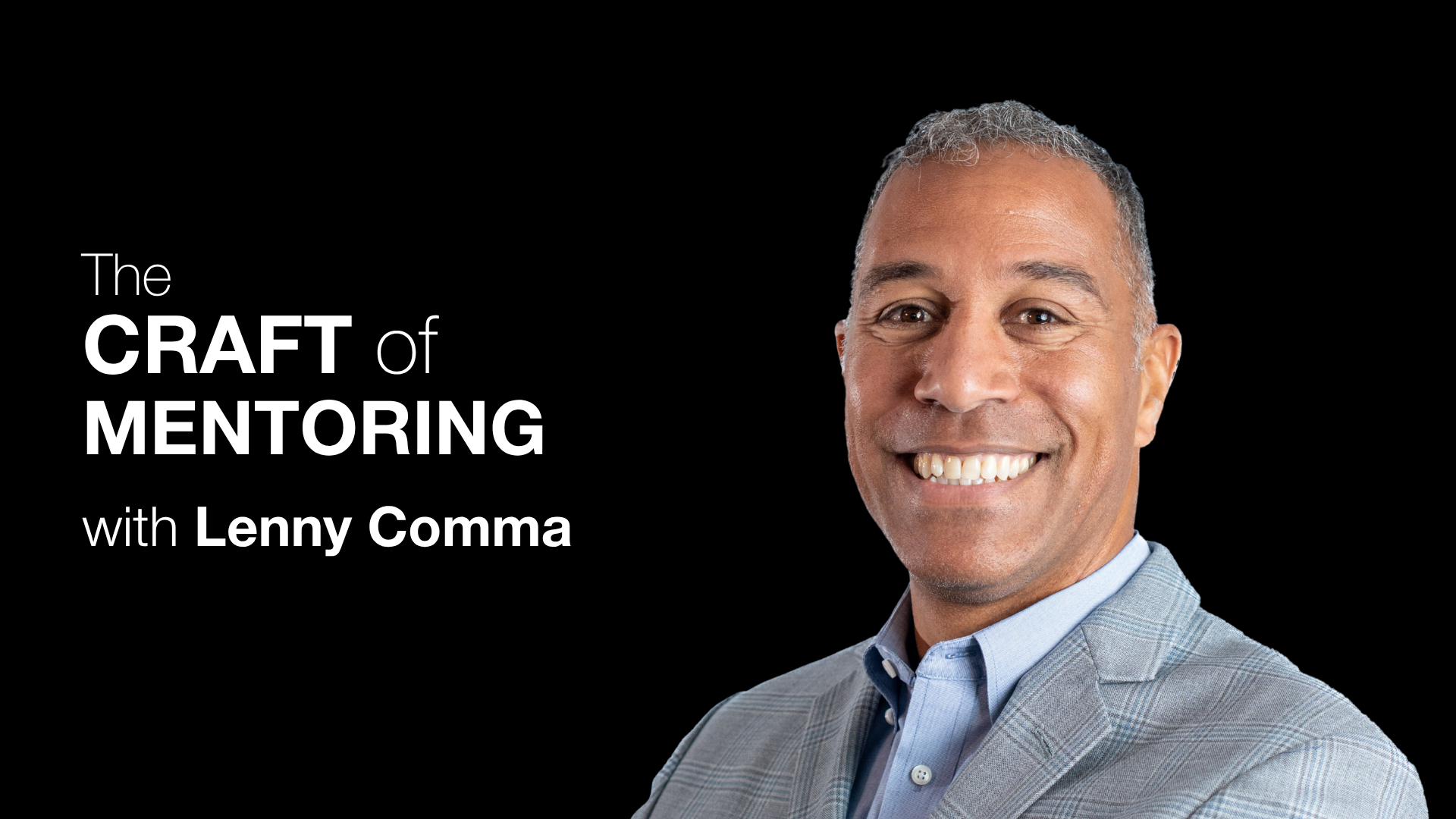
Lenny Comma, former Chairman and CEO of Jack in the Box, and a mentor and coach at The ExCo Group, speaks with Adam Bryant about the three rivers that must merge for effective mentoring, why hiking with clients unlocks deeper insights, and the lesson from a boss that taught him to always shoot straight like an arrow.
Q. What have you found to be the secret sauce of effective coaching and mentoring?
A. To use a metaphor, I think of it in terms of three rivers that we’re trying to merge. And when they do merge, that’s when the magic happens.
The first river is about credibility, which comes from our real-world experience. But our clients don’t just receive that with open arms. They want to get into gray-space conversations to find out if you actually understand what it’s like to sit in their seats and live in their world. Once you have enough rapport within that gray space, people tend to really open up, because they figure out that you get it.
The second one is having the EQ to develop deep levels of trust with your mentee. All the executives we work with in these roles have a track record of success in building trusting relationships within the professional environment. They have reasonably high EQ themselves, and they know how to relate to people. So that’s the second river that needs to merge—this ability to connect with individuals to build a deep level of trust.
The third one is the ability to catalyze insights through inquiry. In some cases, that means taking them into environments that help those conversations. For example, I go on a lot of hikes with my clients, because that’s where a lot of great insights happen. So the goal is to always merge those three rivers—credibility, building trust, and catalyzing insights.
Q. Is there a particular tool or framework that you find generally leads to the biggest unlocks?
A. A lot of them are about getting the client to be introspective. The tools I use to do that include the lifeline exercise, where they share the highs and lows of their life, starting at an early age. I’m listening for the threads that run through their lives. The LVA (Leadership Values Assessment) is phenomenal, as well, because it’s a simple and powerful way for our clients to understand whether others perceive them in the ways they intend. When there are gaps, how do we work on closing them?
And the leadership accelerator is an opportunity to take all the work we’ve done and put it in a slow cooker to answer the question, what are we going to do? We have the ingredients at that point, but ultimately we want to come out with a clear action plan and a handful of priorities for them to work on.
Q. Is there a story you can share about a tough conversation you had to have with a client that ultimately ended in a good place?
A. I had a client who had been promoted into a senior role, and he was struggling in his new position. The CEO and the CHRO were baffled by what seemed like a radical change in his behavior, and they were starting to think that my client couldn’t turn things around.
But he was still fully engaged, and he wanted a coach. When we did the lifeline, it became clear that he had some experiences growing up and early in his professional life that had created some scar tissue. Some of the experiences he was having with the current CEO and the board were triggering some of that old scar tissue. So his responses were outsized compared to the stimuli.
We had a lot of conversations about where some of those trust issues came from, and he was able to clearly see the thread that ran through his life. He accepted that he was responding more to his perception of his current situation rather than the reality of it.
After about six months, there was a dramatic and noticeable change in how he was showing up as a professional, both as a leader of his direct team and also with the board and his colleagues on the leadership team.
Q. What is the best lesson that you learned yourself from one of your mentors over the years?
A. It was a simple lesson that required a bit of background. I grew up in New York, and in some ways, it was the stereotypical New York environment where everybody’s trying to figure out an angle. It’s the sort of environment where you could, of course, buy something at a store, but if someone was selling the same thing off the back of a truck at a cheaper price, that was the better option, even if you didn’t know where it came from. I wasn’t raised that way, but being in that environment, there were plenty of times that I was either tempted or did allow myself to benefit from a shortcut.
When I got into my professional career, one holdover from growing up in that environment was that I always felt that I could talk my way into and out of most situations, and that I could massage the truth in a way that would make people feel good.
I had this boss who was just a phenomenal human being and leader, and he coached me to communicate in ways that were exceptionally simple and to always shoot straight like an arrow. That’s the term that he planted in my heart, and he exemplified it in hundreds of ways.
After a particularly intense period of work, for instance, he took a bunch of us to a Sports Authority as a thank you and said we could pick out what we wanted. I chose a running watch, and when we left, he saw on the receipt that they didn’t ring up the watch. And he said, “We have to go back in and take care of this.” Not in a million years would anybody I grew up with ever do what he did.
There were so many other examples of what he taught me. There was a time when we were rolling out a new program at our company that would have the effect of taking power and authority away from business units because we were centralizing it more. I was trying to make those business units feel good about the change—I told them we were going to work together on this, and it wasn’t a huge change.
My boss got upset with me, explaining that the leaders of those business units now thought they were going to have more authority than they actually were going to have. He asked, how do you think they’re going to feel once they realize you didn’t shoot straight with them?
The lasting lesson is to always be brutally honest and straight with people, so that there can be no misinterpretation of what you’re saying. That’s the foundation you can always stand on if anyone ever comes back and questions you.
Q. What is the wisest thing you’ve ever read, heard, or said in the context of leadership?
A. It’s from the poet Marianne Williamson. In her poem, “Our Deepest Fear,” she writes: “Our deepest fear is not that we are inadequate. Our deepest fear is that we are powerful beyond measure.”
Those words really challenge the tension that exists within our inner belief system. There’s a part of you that inherently knows your potential but is afraid to lean into it for all sorts of reasons. Maybe it’s fear of failure, maybe it’s fear of responsibility, maybe it’s imposter syndrome. There are all sorts of things that can get in the way of people leaning into their talents.
That means they play it safe and never experience the highs associated of taking on big new challenges, but they also never experience the lows of failure and disappointment. That poem inspired me to be myself and lean into my strengths, knowing that it wouldn’t always work out well, but that life was going to be way more fulfilling knowing that I tried, rather than playing it safe.
The phrase I always used with colleagues at work was, “Never let fear hold you back.” When I shared it with people, they would often hear it as me saying that they should be fearless. But it’s natural to have fear. We should have fear, and there are times when it is going to tell us something that we need to respond to.
What I am saying is that there are moments in life when opportunities are presented to us and we don’t pursue them, we don’t initiate, or we don’t act. And the only reason we don’t is because we’re letting fear hold us back, instead of leaning into trusting ourselves and our ability, and then at least trying.
Recent