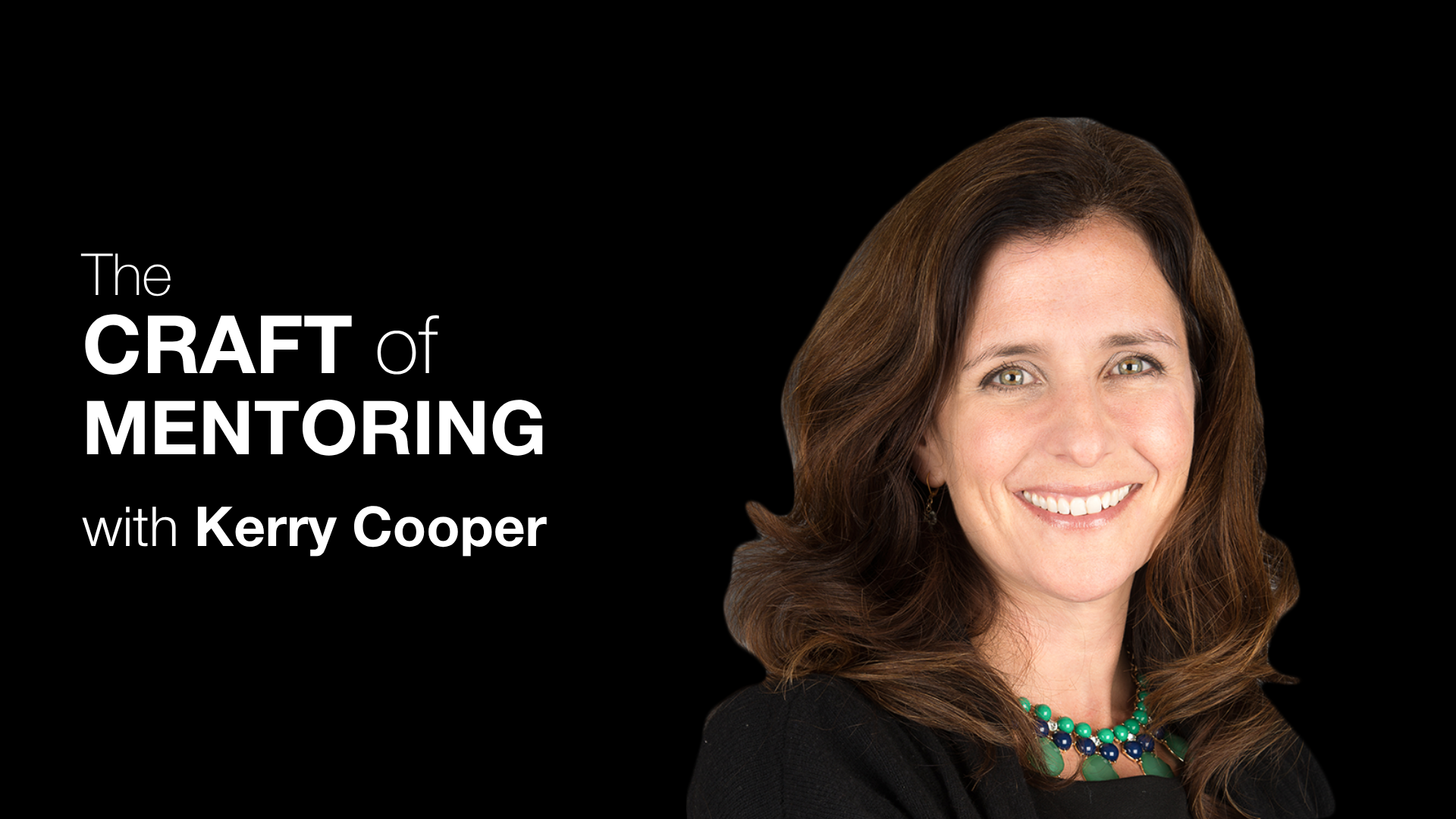
Kerry Whorton Cooper, former President & COO of Rothy’s, and a mentor and coach at The ExCo Group, speaks with Adam Bryant about why vulnerability is essential to building trust, how to balance asking questions with sharing your own experiences, and the importance of pursuing work that brings you joy rather than just work you happen to be good at.
Bryant: What do you consider to be the secret sauce of effective mentoring?
Cooper: Connection and chemistry really matter. And you have to be vulnerable, which is key to building trust. A big part of mentoring is creating a relationship where our clients can be vulnerable with us about what’s really going on and what’s really driving their thinking and their behavior. They may have this thing that they think they are working on, but is there something underneath that we need to discuss?
And vulnerability is a two-way street. I have to be open and vulnerable, as well, about some of the things that I’ve dealt with. The beauty of the way we work is that our mentors at ExCo have been in these leadership roles themselves. And so you share what you learned from what went well and also from those moments when you blew it.
It’s a different kind of coaching, because in traditional coaching training, the assumption is that the client always has the answer themselves, and that your job is to ask questions so that they discover the answer on their own. But sometimes our clients want to hear our opinions and our stories, too.
It’s about finding that balance, and it’s similar to the balance I try to strike as a board director. How do you ask the question that gets them to rethink their strategy by sharing your story of what happened when you tried something similar? Then you ask, do you think that might apply here?
I think it is helpful that our clients know that we have been in their seat, or certainly a similar seat, because it helps you ask questions that push their thinking. I have a client who runs e-commerce for a large tech company. My background includes running e-commerce for a large retailer, so I can ask questions about their thinking around architecture and strategy. That helps them think about what’s really going on behind the problem they think they’re trying to solve.
Bryant: Is there a tool or framework or a particular kind of conversation that you find leads to the biggest unlocks for you?
Cooper: I love the Leadership Values Assessment because it’s a powerful way to help our clients become vulnerable about what their most important values are, and whether those are aligned with how others see them showing up. It gets to the heart of who you are, how you want to be seen, and how others see you. It’s such a gift to get that kind of feedback.
Bryant: What’s the best lesson you ever learned from one of your mentors?
Cooper: One of my favorite bosses was very much a first-principles thinker. He would always ask about why you’re doing what you’re doing, and push you to be very clear on the “why.” It wasn’t so much a lesson, but he role-modeled one of the strengths of great leaders, which is to help you crystallize your thinking by asking great questions.
Bryant: What is a “Kerry-ism” that you’ve found yourself repeating often over the years?
Cooper: “Don’t get good at something you don’t enjoy.” I’m really good at business modeling. I can make Excel sing. I can spend hours doing it and turn stuff around faster than most people. But I really don’t love it. It was a colleague at a start-up who opened my eyes to thinking more about the things that bring me joy, and doing that for my job rather than the things I just happen to be good at.
And as I found later in my career, it turns out that being really good at something makes you a great boss, because you can ask smart questions about it without having to do the work yourself.
Bryant: It’s an important point—if somebody is considered good at something, there’s usually an assumption by their bosses that they just want to do more of that.
Cooper: You have to be careful of the word “should.” Because a lot of people will tell you what you should do. But what do you want? It’s a gift to have somebody around you who can point out those moments when your eyes are shining and when you’re sparkling. If you woke up every morning knowing you could do that for your job, you would jump out of bed.
Recent










 English
 English (UK)