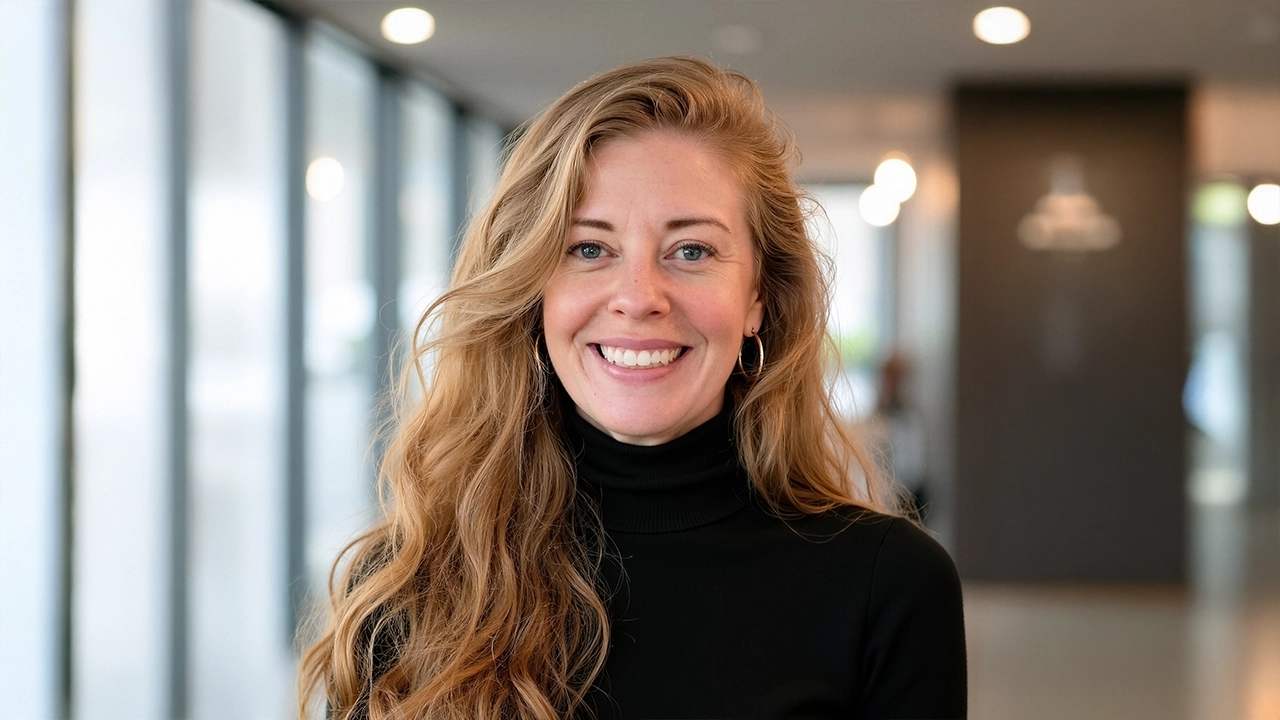
Liz Almeida, CHRO of Panasonic North America, shares her leadership insights with Adam Bryant and David Reimer. In this conversation, she explores how organizations must build emotional intelligence to navigate the future of work, why leaders need to embrace vulnerability and let go of having all the answers, and the importance of understanding how younger generations form meaningful connections in the workplace.
Reimer: What challenges are top of mind for you these days?
Almeida: The future of work, and what that will look like, is something that keeps me up at night. I’m curious what the roles will look like, but more importantly, how do we build the emotional intelligence and the empathy that will be needed to guide us through this next revolution of work?
We’re getting wrapped up in technology and all its possibilities, but we’re not having enough conversations about the connective tissue. How will we define the skills needed for how relationships are managed in the workplace?
Bryant: It’s a powerful question. How do you think about answering it?
Almeida: The first step is recognizing that there’s a gap and an opportunity to learn that skill. What does that skill look like? How do you apply it, and how do you take others with you in developing that skill?
I came from a generation that lived outside of the house most of the time when I was growing up. I built connections in a different way, and now I’ve got a generation coming into the workforce that leverages technology and interacts in different ways than I do. There’s going to be a huge gap between us, and I think other organizations will be experiencing this, as well.
As a leader, the first responsibility I have is to lean in and learn more about how those connections are happening differently. I still don’t fully understand how Gen Z are forming deep connections. But there is something there that’s different, and I have to better understand it. So I’m trying to really bring them into the conversation around what the employee experience means to them. What is meaningful to you? How do we co-create that experience in a way that’s really going to drive engagement?
I had a completely different corporate upbringing. It was almost more like a hazing than it was onboarding. You worked for 12 hours. Sometimes you slept in the office, and you kept a clean shirt handy for the next day. That was just expected. That is not going to be acceptable going forward.
Reimer: How do you think about workforce planning over long time horizons, given all the uncertainty?
Almeida: I don’t have the answers. I do have a lot of questions, and they include, do we understand the skills and capabilities that we’re going to need to get to that end-state that we’re driving toward? Do we understand what we’re solving for? And do we have the leaders at the next levels down to help drive the development of their teams to have the right capabilities and also reshape themselves?
Long gone are the days when you’re solving for things in just your function. Leaders really need to be solving problems left to right and thinking about end-to-end processes, as opposed to being a very deep subject-matter expert. That’s a hard habit to break. We’re at an inflection point where we’re going to be tossed in a completely different direction than I think any of us can fully anticipate.
Bryant: Your job must seem so challenging at times, given all the big questions you are wrestling with and for which there are no obvious answers.
Almeida: It’s very intellectually stimulating to me. It’s like a Rubik’s cube we’re solving. And yes, at times it can feel overwhelming, but I’ve never been in a role that didn’t have a lot of challenges. I thrive under those conditions.
I’m also lucky enough to have a lot of great peers at the executive level who will lean in and say to me, take a beat—”You’ve been in back-to-back meetings for what feels like six weeks, and you need some time and space to let your brain process things.”
They do it out of a deep care for my personal health, but they understand that we’re all important in that equation at the leadership level. We have to watch out for each other and be able to have those kinds of conversations that come out of a place of compassion.
Reimer: What were early influences that shaped who you are today?
Almeida: I’m first-generation in this country, raised by a single mother who didn’t speak English, and I didn’t speak English right away, either. I was what people often call a latchkey kid. I didn’t have a lot of parental oversight. There wasn’t a safety net there.
So I had to figure out a lot of things on my own. Failure was not an option, and if you did fail, you just had to dust yourself off and get back out there. Nobody was going to come and save me from a situation. So I learned that resilience.
My mom would always tell me, “If somebody else has done it, there’s no reason why you can’t do it, too. And if nobody else has done it, then you’ll be the first to do it.” She would just shove me out the door and send me on my way. I never felt like I had any other option but to keep moving forward.
Bryant: What was a key lesson you learned once you stepped into the CHRO role?
Almeida: The most important lesson for me was that I had to embrace the fact that I was not going to have all the answers. That was uncomfortable for me, at first, and I had to get out of the way of my team to solve things.
My impulse on certain issues might have been to take the steering wheel from them and dive into the data myself. That’s not my job anymore. I had to learn to let go and trust. I had to empower my team and learn that my job was to clear the runway so they could take off.
Reimer: How do you hire? What qualities do you look for, and what questions do you ask?
Almeida: I’m trying to understand their drivers and motivators. Why are they interested in this role now? And are they displaying curiosity—not just about the company or the role, but also about other aspects of their life?
Yes, we all need people who can solve problems. But I also look for people who can identify the problem statement. How do they know which problem to solve for? It’s really easy to chase a problem, but is it the right problem to solve now?
One of the questions I like to ask is, tell me about a problem that you just sat and stared at, and why? Because sometimes those problems solve themselves. People can be really eager to get in there and, with the best of intentions, want to solve things quickly. But do you have the self-awareness to take a beat and stop and stare at the problem and understand that it might be a symptom of a different problem.
Bryant: How do you complete the sentence, The hardest part of leadership is…?
Almeida: Being vulnerable. It’s okay to be vulnerable, but there’s this idea that leadership means you have to have some sort of superhero cape or that you have to be a machine—you can’t have emotions, you can’t take time to process things, you can’t get sick.
Leadership can be lonely. I recently came across an HBR study of 109 CEOs that found episodes of loneliness are common, even among leaders surrounded by people all day. I don’t think a lot of leaders even outside the C-suite truly anticipate or process that fully. I certainly did not.
I like working—it’s fun and fulfilling for me—but it can still be incredibly isolating at times. I’m still a human being. I’m going to have moments when my family needs me or to deal with other things that come up just as part of everyday life. That’s why it’s so important that I have the grace from other leaders in the organization and that they recognize that I’m a whole person and not just a title.
Recent