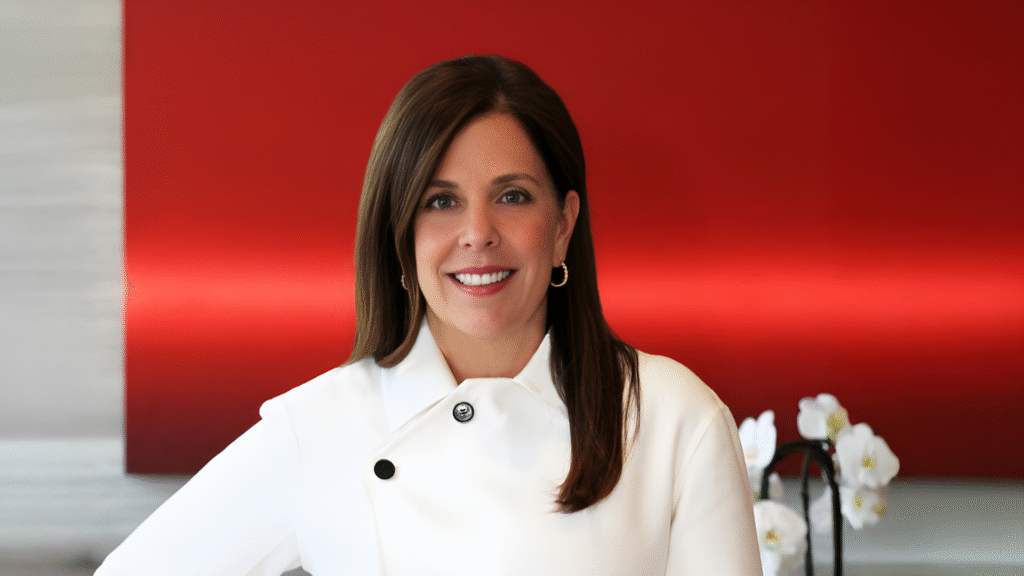
Elizabeth Ahmed, Executive Vice President of People and Communications at Unum Group, shared her leadership insights with David Reimer and Adam Bryant in this Strategic CHRO conversation. She discusses why mental health is not a side conversation, the evolving expectations of HR leaders, and the role of emotional intelligence in building future-ready teams.
Reimer: What issues are top-of-mind for you these days?
Ahmed: A big one is around simplifying complexity in everything we do for our employees and for our clients. That’s linked to the second thing I spend a lot of time thinking about, which is the need for a holistic approach to wellbeing that includes physical, financial, emotional, and social wellbeing.
It has become more important since the pandemic. We are seeing the stresses and we’ve got to respond with targeted programs. We have to think about extending support for employees in a different way. We are seeing a sustained rise in mental health claims, both internally and across the whole industry.
Mental health is not a side conversation any longer. It’s central to having a strong, smart workforce strategy. Employees need to have the right tools in their hands at the moments that really matter. We have to invest in mental health. It’s not just about being compassionate. It’s a business imperative to protect overall productivity and competitiveness. That’s something that I think a lot of HR leaders are struggling with right now.
Bryant: You’ve got a very broad portfolio of responsibilities. We’re seeing a lot of HR leaders who are responsible for much more than just HR.
Ahmed: The pandemic was a catalyst that drove people organizations to be the strategic driver of transformations. CHROs became central to business continuity, workforce resilience, and organizational agility. They were managing every aspect of a rapidly changing workforce. The importance of that role has only been reinforced over time.
It requires a really deep integration with the CEO, the rest of the C-suite, and the board to directly influence the business strategy. The expectations have evolved, and HR organizations are expected to lead with empathy and act with speed, and they’re balancing people-centric approaches with measurable business impacts.
Reimer: What are the X factors that you’re looking for in your strongest leaders?
Ahmed: One that has always been important is emotional intelligence. And it’s going to be even more important because it can amplify the ability to use AI and to ensure that decisions are not just smart but also humane.
I also look for resilience under pressure. I want people who can adapt and recover quickly. You have to be able to stay calm and focus when the stakes are high. Resilience isn’t just about endurance—it’s the ability to recharge and come back stronger.
The third one is intellectual curiosity. I’m looking for people who ask questions and who challenge assumptions. I’m looking for someone who is never satisfied with the surface answer. They want to go a little deeper.
Bryant: What were important early influences for you?
Ahmed: My dad took me everywhere when I was young. He made beer for a living—he was Head Brewer at what is now one of the large brewing companies. I grew up in England, and he would often take me along when he would visit the breweries.
He taught me how to solve problems on the shop floor. I would sometimes work shifts with him when he would give his employees time off at Christmas. He taught me about labor relations, customer-service issues, and dealing with landlords. I grew up in that kind of environment, and he always taught me that I could be whatever I wanted to be.
I’ve never been bored, and I’ve always had leaders who put me in challenging situations and have asked me to rise to the occasion. I’ve also raised my hand to find new opportunities, too. I love solving problems.
Reimer: What are the tools and skills that the CHRO of the future will need that are different than the past?
Ahmed: HR people have to be a lot more adaptable today. We’re building workforces that are changing much faster in terms of skills than they were when I first started, and technology is making that happen.
The CHROs of the future will need that deep business acumen, and that includes being much more fluent in data analytics. And as I mentioned, EQ is more critical now than at the beginning of my career, because AI is going to take over a lot more of those transactional tasks that HR people did when I started. The human connection of HR is still going to be the differentiator.
Bryant: How do you hire? What questions do you typically ask in job interviews?
Ahmed: I touched on some of the qualities I look for before, but I’ll also mention the importance of strategic thinking. I’m looking for someone who can connect dots, anticipate challenges, and propose solutions.
One question I like to ask is, what external trends do you believe will most impact our business in the next three to five years, and how would you position the organization to best respond?
And I’m looking for team players. Collaboration is key, not just for my team but also at Unum Group overall. I’m looking for that spirit of partnership. I’ll often ask people to give me an example of a time when they had to align on competing priorities across a peer group.
Reimer: Here’s a speed round of three questions. How would you finish each of these sentences:
“The hardest part of leadership today is…”
Ahmed: Maintaining your humanity.
“The highest cost of leadership today is…”
Ahmed: Knowing when to run fast and when to slow down.
“The most rewarding part of leadership today is…”
Ahmed: Seeing people succeed when you played a small part in their story.
Recent